
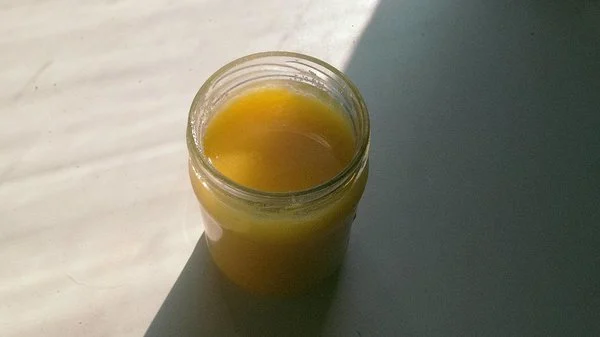
Ghee – clarified butter, or butter oil – is a golden fat, an excellent foodstuff, medicine and cosmetic. The making of ghee can be viewed as an alchemical process, during which a coarser, lower-grade butter is transformed into a golden liquid gold. As an Ayurvedic practitioner, I am a devoted fan of ghee, and this love has lasted for nearly nine years. Why do I hold ghee in such high regard?
1. Numerous therapeutic properties
Ghee promotes health in countless ways and is also suitable for most people who cannot tolerate the casein or lactose found in milk – these are removed during the ghee-making process. The quality of the raw material – the butter – is crucial: the ideal ghee is made from the milk fat of cows raised on a grass-fed diet and cared for with love.
- When consumed internally, ghee is absorbed through the digestive tract into all tissues, nourishing, healing and renewing the skin, plasma and blood, fat, muscle, nerve and bone tissues, bone marrow and reproductive cells – thereby supporting both fertility and immunity.
- According to Ayurvedic wisdom, ghee helps to channel the power of medicinal herbs and healing spices into the body’s deepest tissues – exactly where it is needed.
- Ghee improves intellect, brain function, memory and eyesight; it strengthens the voice and makes its tone more melodious; and it aids the digestion of fats, reducing blood cholesterol levels when consumed in moderation. According to research, ghee may inhibit the formation of cancer cells and have antiviral properties.
- When consumed in moderation, ghee acts either as a reducer of internal intensity or as a gentle aid to digestion – whichever is needed at the time. In this way, ghee promotes homeostasis – the body’s ability to heal itself – and guides us towards the golden mean of moderation, bringing calm to both digestion and the mind.
Tip. When used externally, ghee’s cooling effect soothes minor sunburn, helps prevent blisters and reduces scarring. Ghee is suitable, for example, for preventing stretch marks and sunburn. I have successfully used ghee instead of sun cream in the Alps to protect both my own and my child’s facial skin from the sun, wind and cold.
2. Indispensable in the kitchen
Ghee makes food taste delicious and is indispensable in our kitchen. Furthermore, ghee aids digestion by ‘igniting the digestive fire’: food prepared with ghee is easier to digest and its nutrients are more readily absorbed.
- Ghee can withstand high heat and does not go rancid – unlike butter. Most vegetable oils, with the exception of palm and coconut oil, become indigestible when heated.
- Ghee keeps on the kitchen shelf for at least six months. Vegetable oils, on the other hand, oxidise and go rancid quite quickly once the bottle has been opened. According to tradition, ghee never goes off and its qualities only improve with time – although it is rather unlikely that ghee will be left unused for long.
- Ghee lubricates the body’s internal channels, helps prevent blockages and, when used in moderation, does not contribute to weight gain.
- The ideal amount of ghee to use in cooking is half to one teaspoon per portion.
- Ghee is also good for frying meat and fish, as it aids the digestion of animal fats.
- Foods prepared with ghee provide a sense of enjoyment whilst eating and a feeling of contentment afterwards, whilst also reducing cravings for sweet things. Your sense of taste adapts: as you get used to it, you’ll come to prefer ghee over lower-quality fats.
Olive oil is best used cold – in pesto, hummus, salads or drizzled over soup – but it should not be heated. I do not use coconut or palm oil for environmental reasons; besides, coconut oil goes rancid quickly. Sesame oil has a longer shelf life and can withstand high temperatures. From an ecological point of view, ghee is the best fat, as it is a local product and supports the economy in Estonia.
Kitchen tips.
- Our family’s favourite dish is oven-roasted vegetables with ghee. I mix chopped seasonal vegetables with ghee and salt in a pan, spread them out on a baking tray and roast them for 15 minutes in an oven at 200 degrees. I sprinkle on some sage, thyme or rosemary. This dish is a hit with both children and adults; it’s easy to digest and never gets boring.
- Onions, garlic and grated carrots, heated in ghee with spices, make an excellent base for stock, casseroles or soups. For our family’s favourite soup, borscht, I heat ghee with cumin seeds, black mustard seeds, grated ginger and carrots.
- Frying with ghee also makes for delicious pancakes.
You’ll find more Ayurvedic dishes in the posts ‘Autumn Sample Menu’ and ‘Kitcher’.
3. Helps children grow
Ghee supports children’s development and strengthens their immune system. By increasing feelings of calm, love and security, ghee reduces hyperactivity and attention deficit disorders. Restless children can be given half a teaspoon of ghee in a cup of warm water three times a day.
For schoolchildren, ghee aids intellectual development and learning ability. The academic performance of our family’s three children improved when we started using ghee regularly in our meals.
Tip: A healthy snack for children is a mixture of ghee and honey in a ratio of two to one. This super-treat gives children a sense of balance, self-confidence, stability and love – qualities that have become scarce in today’s fast-paced world. It is important to stick to the correct ratio: when used in equal quantities, this combination causes a conflict between digestive enzymes.
4. An excellent cosmetic
Ghee is rich and nourishing, and in our climate during the colder months it makes an excellent day cream, protecting delicate facial skin from environmental pollution, humidity and the cold. I use ghee on chapped lips and a nose prone to redness, to prevent wrinkles and to smooth out those that have already formed. Apart from make-up, ghee is the only cosmetic I use on my face – both as a primer and as a make-up remover. It leaves the skin soft, smooth and silky.
Tip: If you don’t like the smell of ghee, you can turn it into a neutral-smelling moisturising cream. To do this, you’ll need 100 ml of ghee and 100 ml of clean, boiled water at room temperature. Put the ghee and water in a bowl and whisk well until frothy. Then pour off the excess water and repeat the process at least 25 times – the more you wash the ghee, the nicer the cream will be. The ghee turns white, soft and silky. It may take a couple of hours, but the whipped cream is lighter and airier than ghee and is also well suited to oily skin. Finally, you can add a few drops of rose water to scent the cream.
5. A powerful rejuvenator
As we age, our vitality begins to wane, and ghee helps to slow this process very effectively, reducing both internal and external dryness. If your body or skin is excessively dry, drink a cup of warm water mixed with a teaspoon of ghee before breakfast. Externally, nourish your skin with ghee twice a day. You’ll find more tips in the post ‘How to Age Well’.
Tip. Women can also find relief from vaginal dryness and irritation with ghee. Place a suitable amount of ghee in the fridge, roll the solidified ghee into candles of a suitable size, wrap them in foil and store them in the fridge. If necessary, use them vaginally at night. This helps to restore the vagina’s normal microflora using natural remedies.
6. An emotional balancer
Ayurveda teaches that, in addition to its physical and chemical properties – such as calories, carbohydrates and fats – food also has energetic and emotional effects. Ghee has a special effect on the mind, thought processes and emotions.
Ghee promotes mental clarity, an understanding of connections and a sense of wholeness, and fosters feelings of love, care, stability and security more than any other foodstuff. Ghee is the perfect antidote to today’s fast-paced, nervous and superficial lifestyle.
Making high-quality ghee with healing properties requires time, care, love and cooperation. The entire cycle – from caring for cows, where the cow is a cherished household animal, to obtaining milk and butter on a smallholding, right through to making ghee – requires dedication. Love and dedication create love and health, whilst carelessness and haste create negative emotions and illness.
For me, ghee is a symbol of sound peasant wisdom and cooperation. Just like mammoth schools and industrial mass production, large dairy farms are unable to offer care and a human touch – there, a cow is merely a cost-benefit unit. We have every opportunity to obtain high-quality butter right here in Estonia by supporting our own small-scale farming. In my dream eco-Estonia, you would see more dairy herds alongside beef cattle on the green pastures in summer, and small-scale cow farming would be just as natural and supported as it is in Switzerland, for example. It’s particularly lovely to buy butter from a farmer whose farm you can visit with the whole family to see how the cows are looked after.
7. Making ghee is incredibly easy
You’ll get the best ghee from organic butter, but you can also make it from shop-bought butter. Put the desired amount of butter in a saucepan and heat over a medium heat, stirring occasionally, until the butter has melted. Then turn the heat down to the lowest setting and let it simmer gently. Two 180-gram packets of butter will yield about half a litre of ghee.
As it heats up, the butter goes through various stages: it foams, bubbles and crackles. When the process becomes quiet and the mixture in the saucepan becomes translucent, with small, slightly brownish bits at the bottom of the saucepan and a second, lighter foam having formed on top, the ghee is ready. The time taken depends on the quantity; for one or two packs of butter, it takes about 15 minutes. I don’t skim off the foam; instead, I let it set and then strain it out. I use the leftover ghee in cooking – adding it to porridge or soup – or feed it to my farm animals. Nothing goes to waste.
Heating the butter sufficiently is very important for producing high-quality ghee. Allow the ghee to cool slightly, then pour it through a metal sieve lined with muslin or kitchen paper into a glass jar. Ghee keeps best in a glass jar at room temperature, away from direct sunlight. To ensure the ghee keeps well, make sure the butter is heated for long enough, and always use a clean spoon to take it out of the jar.
Ghee is also a central ingredient in home panchakarma: it is used to soften the tissues before cleansing. To find out exactly how this works, read the panchakarma retreat page.